IT Support Impact Summary
Evaluated a multi-site enterprise network to identify architectural weaknesses that could cause inconsistent user performance and difficult troubleshooting. Proposed improvements focused on increasing reliability, centralized visibility, and fault tolerance so support teams can diagnose and resolve connectivity issues faster across locations.
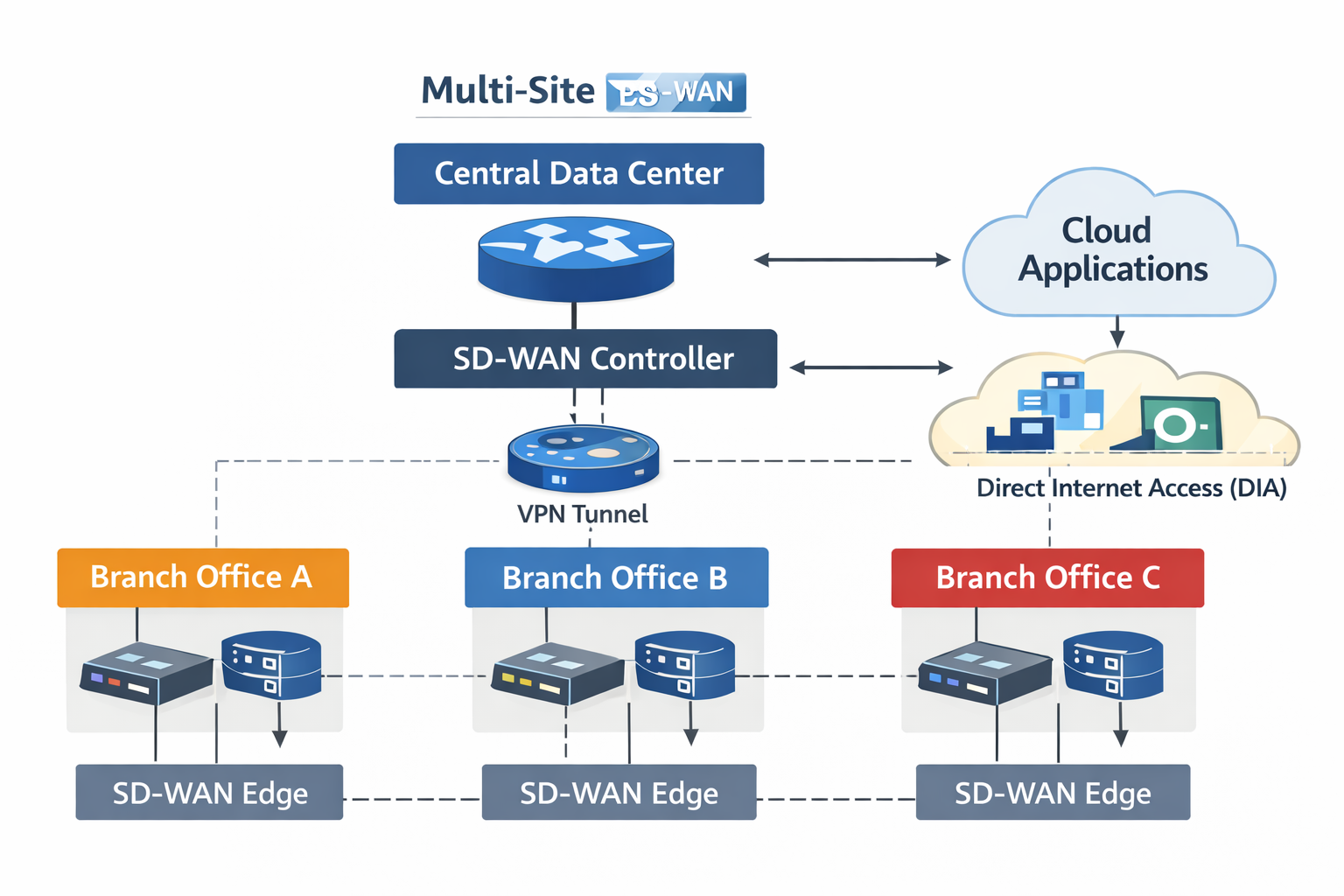
This project evaluates the existing network infrastructure of a growing multi-site company, identifies security and performance weaknesses, and proposes a dual-hub SD-WAN architecture to support additional offices, better resilience, and more consistent policy enforcement.
My role
Assessed current-state architecture, documented operational pain points, proposed the future-state SD-WAN design, and tied network choices to supportability and continuity.
IT support relevance
Shows how I think about user experience, latency, visibility, failover, and how poor design choices create recurring support problems.
Current-state issues
| Finding | User or support impact | Risk level |
|---|---|---|
| Memphis lacked a local firewall | Created a security and availability dependency on Dallas, increasing outage and troubleshooting complexity | High |
| Sites relied on a single WAN connection | Provider outages could interrupt communications and line-of-business applications | High |
| No QoS implementation | VoIP and video traffic competed with bulk data, degrading user-facing services | Medium |
| Limited capacity planning | Bandwidth bottlenecks increased delay for payroll, billing, and database traffic | Medium |
Before vs. after
| Before | After |
|---|---|
| Single-path WAN dependencies | Dual-hub SD-WAN with failover-ready paths |
| Limited monitoring visibility | Centralized monitoring and log correlation |
| Inconsistent policy enforcement | More consistent security policy across locations |
| Harder to isolate site-specific issues | Better path control and simpler fault isolation |
Key design decisions
- Dallas and Houston operate as redundant SD-WAN hub sites, with Memphis and Kansas City as spokes.
- Each site uses dual WAN links, with SD-WAN steering traffic across primary and backup paths.
- End-to-end IPsec VPN tunnels protect intersite traffic, while SSL VPN supports secure remote access.
- SolarWinds and Splunk add centralized visibility for faster issue detection and escalation.
Key design decision
SD-WAN was selected because it centralizes policy enforcement and monitoring while improving resilience and reducing the number of location-specific mystery problems that support teams have to chase manually.
What this proves
I believe this project shows that I can connect architecture choices to uptime, troubleshooting workload, user experience, and business continuity instead of treating network design like an isolated diagram exercise.